Bending the Sierra Madre Oriental":" A Paleocene Orocline
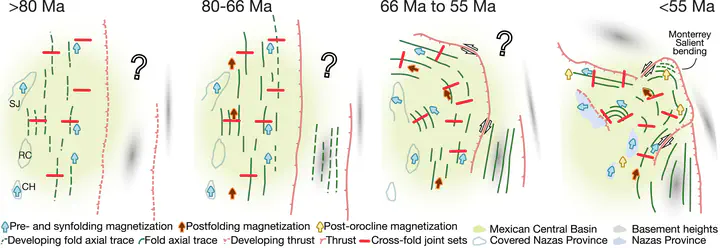 Simplified kinematic reconstruction of the Sierra Madre Oriental Orocline
Abstract
The Sierra Madre Oriental belt of the Mexican thin-skinned fold-and-thrust belt, which formed during the Late Cretaceous due to the subduction of the Farallon Plate beneath North America, exhibits a pronounced curvature of approximately 100°, concave to the southwest. A recent paleomagnetic study in Jurassic rocks has classified the curvature of the Sierra Madre Oriental as an orocline. However, orocline formation remains loosely dated as syn-to post-orogenic, ranging from 120 to 50 Ma, which is the timing of the main deformation in the region. This poorly constrained kinematics prevented proposing a mechanism for the oroclinal bending, leaving both the tectonic driver and kinematics unresolved. In this study, we investigate the Cretaceous Taraises Formation along the curvature of the Sierra Madre Oriental Orocline to unravel its kinematics of formation. Our new paleomagnetic data set, along with joint-set analysis in 25 anticlines, allows for fold-tests and reveals pre-, syn-, and post-folding magnetizations that indicate ∼90° counterclockwise rotations with respect to the north, in the northern limb of the orocline and ∼30° clockwise rotations in its southern limb. Paleomagnetic data constrain the timing of the oroclinal bending to the Paleocene (66–55 Ma), which is later than the main thin-skinned folding event in the area.

Daniel Pastor-Galán
Científico Titular and Assistant Professor (助教) of Tectonics
My research interests include plate tectonics, paleogeogrphy and geodynamics.