A ∼1.6 Ga accretionary event in the polymetamorphic Lesser Himalaya, India: Insights into late-stage assembly of the Columbia supercontinent
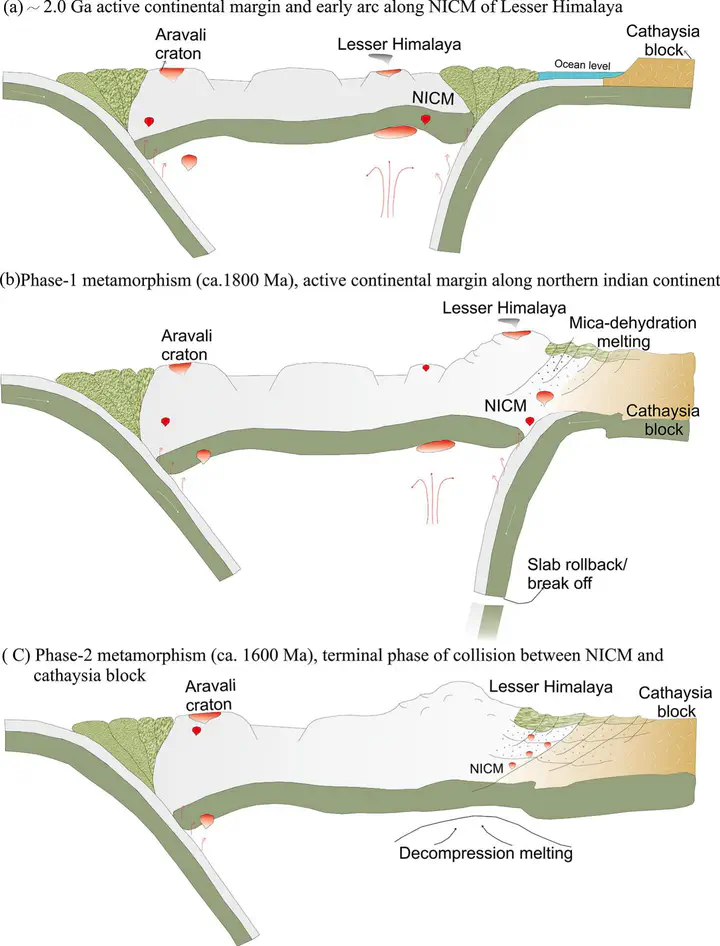 Model depicting tectonometamorphic evolution of the Paleoproterozoic Lesser Himalayan metapelitic gneisses during Columbia assembly.
Abstract
A series of collisions among most of the continental fragments between 2.1 Ga and 1.8 Ga culminated in the assembly of the Columbia supercontinent. Vestiges of reworked Northern Indian Continental Margin, involved in the Columbia supercontinent assembly, are preserved and known as the ‘Paleoproterozoic high-grade metapelitic gneisses in the Askot Klippe’ of NW Lesser Himalaya. We report new whole-rock geochemistry, inverse and forward geothermobarometric modeling, isochemical phase diagram modeling, and U–Pb zircon dating of metapelitic schists and gneisses to decode the multiple metamorphic histories in Lesser Himalayan fold-thrust. We identify two metamorphic events that mark the Columbia Supercontinent assembly’s accretion phases: an earlier ca. 1.85 Ga age related to the first metamorphic episode and a second age of ca. 1.62 Ga associated with the youngest reported collisional event related to subduction followed by accretion of crust and attendant crustal anatexis. The earlier event reached upper green-schist facies metamorphism during which garnet cores crystallized, whereas the second event indicates amphibolite-granulite peak metamorphic conditions. Our results show that the amalgamation of Columbia persisted until at least ca. 1.62 Ga in the northwestern Lesser Himalaya, indicating tectonic continuity between the northern Indian continental margin, the Aravalli–Delhi Mobile Belt, and the Eastern Cathaysia Block—key elements in the final Paleoproterozoic assembly of the Columbia supercontinent.

Daniel Pastor-Galán
Científico Titular and Assistant Professor (助教) of Tectonics
My research interests include plate tectonics, paleogeogrphy and geodynamics.