How fast is too fast? Izanagi's roll-back on the run
 The Poster
Abstract
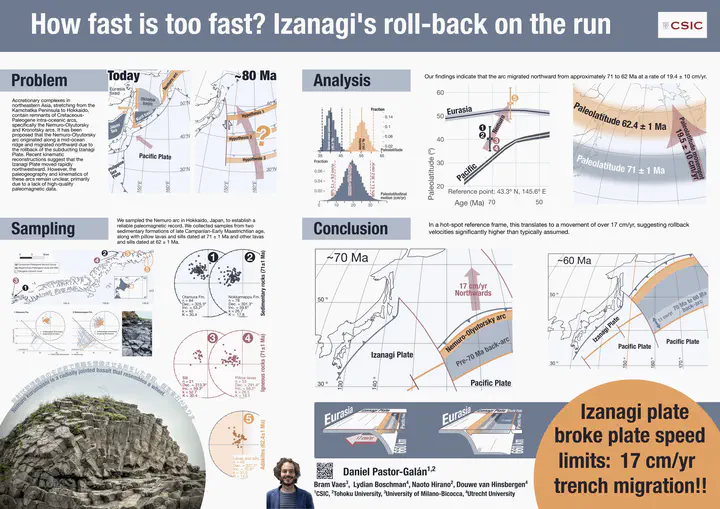
Understanding the tectonic evolution of oceanic plates is challenging due to their eventual subduction and loss. Marine magnetic anomalies on the Pacific Plate indicate that at least three plates once existed within the Panthalassa Ocean, all interacting with the Pacific Plate along spreading ridges. Global plate tectonic reconstructions suggest that Panthalassa initially featured a three-plate system with a central triple junction before the Early Jurassic inception of the Pacific Plate, eventually transitioning to a four-plate system. Accretionary complexes in northeastern Asia, stretching from the Kamchatka Peninsula to Hokkaido, contain remnants of Cretaceous-Paleogene intra-oceanic arcs, specifically the Nemuro-Olyutorsky and Kronotsky arcs. It has been proposed that the Nemuro-Olyutorsky arc originated along a mid-ocean ridge and migrated northward due to the rollback of the subducting Izanagi Plate. Recent kinematic reconstructions suggest that the Izanagi Plate moved rapidly northwestward. However, the paleogeography and kinematics of these arcs remain unclear, primarily due to a lack of high-quality paleomagnetic data. To clarify this, we sampled the Nemuro-Olyutorsky arc in Hokkaido, Japan, aiming to establish a reliable paleomagnetic record. The Nemuro Belt in eastern Hokkaido comprises forearc sedimentary sequences and juvenile intra-oceanic arc rocks from the Campanian to Paleocene. We collected samples from two sedimentary formations of late Campanian-Early Maastrichtian age, sufficient for elongation-inclination correction, along with pillow lavas and sills dated at 71 ± 1 Ma and other lavas and sills dated at 62 ± 1 Ma. Our findings indicate that the arc migrated northward from approximately 71 to 62 Ma at a rate of 19.4 ± 10 cm/yr (Fig. 1). In a hot-spot reference frame, this translates to a movement of over 15 cm/yr, suggesting rollback velocities significantly higher than typically assumed.
Daniel Pastor-Galán
Científico Titular and Assistant Professor (助教) of Tectonics
My research interests include plate tectonics, paleogeogrphy and geodynamics.